From Original to Certified True Copy: Understanding Document Certification in the UAE

Documents play an important role in personal, legal, business, immigration, banking, property, and government transactions in the United Arab Emirates. In many situations, you may be asked to provide a Certified True Copy of an original document instead of submitting the original itself.
But what exactly is a Certified True Copy? When is it required, and how can you obtain one in the UAE?
At Key Corner Legal, we provide professional Certified True Copy Services in the UAE, helping individuals and businesses prepare and certify copies of important documents for legitimate legal and administrative purposes.
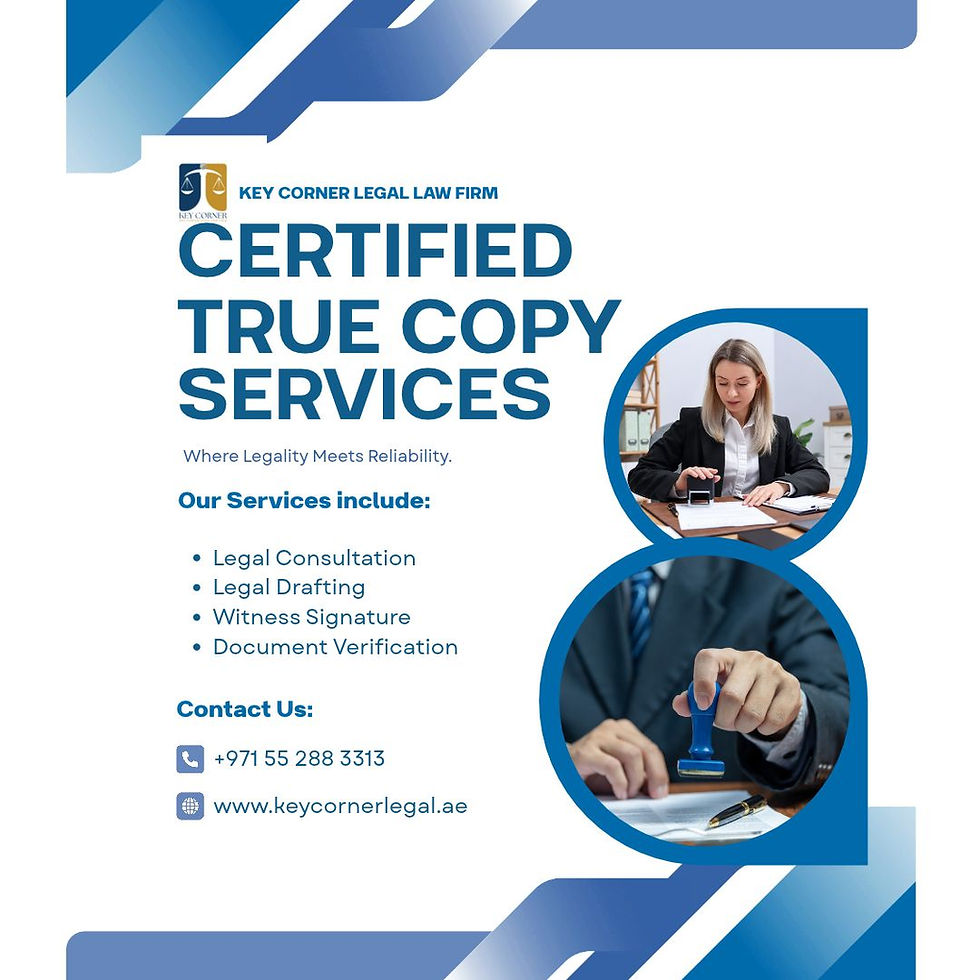
What Is a Certified True Copy?
A Certified True Copy (CTC) is a copy of an original document that has been examined against the original and certified as a true and accurate copy by an authorized person or professional, subject to the requirements of the receiving authority.
The certification generally confirms that the copy corresponds to the original document presented for verification.
A Certified True Copy is different from simply making a photocopy or scanning a document. The certification provides an additional level of verification that may be required by a particular organization, authority, institution, or transaction.
Why Are Certified True Copies Important in the UAE?
Submitting original documents can sometimes be inconvenient or risky. Important documents such as passports, educational certificates, licenses, contracts, corporate records, identification documents, and other legal papers may need to remain safely with their owners.
A Certified True Copy can be useful when an organization requires evidence of a document without requiring the original to be permanently submitted.
Depending on the purpose and receiving authority, Certified True Copies may be requested for:
Legal and court-related matters
Business and corporate transactions
Banking and financial procedures
Immigration and visa-related processes
Educational applications
Employment-related documentation
Property and real estate transactions
Corporate compliance
Government and administrative procedures
International transactions
Due diligence and document verification
The exact requirements can vary depending on the institution receiving the document.
What Documents Can Be Certified as True Copies?
The documents that may be suitable for Certified True Copy certification depend on the circumstances and the requirements of the receiving authority.
Common examples may include:
Personal Documents
Passport copies
Emirates ID copies
Identification documents
Marriage certificates
Birth certificates
Other personal records
Educational Documents
Degree certificates
Diplomas
Academic certificates
Transcripts and related educational records
Business Documents
Trade licenses
Shareholder documents
Corporate certificates
Company agreements
Board resolutions
Commercial documents
Business registration records
Legal Documents
Contracts
Agreements
Powers of Attorney
Declarations
Affidavits
Legal correspondence
Other documents where certified copies are accepted
Before certification, it is important to determine whether the intended recipient specifically requires a Certified True Copy and whether any additional attestation, legalization, translation, or authentication is required.
Certified True Copy vs. Photocopy: What Is the Difference?
A regular photocopy simply reproduces the contents of an original document.
A Certified True Copy involves an authorized certification process in which the copy is compared with the original document and certified according to the applicable requirements.
In simple terms:
Photocopy: A reproduction of the document.
Certified True Copy: A copy that has been examined against the original and formally certified as a true copy by the appropriate certifying party.
This distinction can be important when submitting documents to organizations that require formal certification.
Does a Certified True Copy Mean the Document Is Attested?
Not necessarily.
This is an important distinction.
Certified True Copy certification and document attestation are different processes and serve different purposes.
A Certified True Copy generally confirms that the copy corresponds to the original document presented for comparison.
Attestation or legalization may involve authentication by relevant authorities, depending on the type of document and where it will be used.
For example, a receiving authority may require:
A Certified True Copy;
Document attestation;
Embassy or consular legalization;
Translation;
Additional authentication.
Therefore, you should always confirm the specific requirements of the organization or authority requesting the document.
When Might You Need a Certified True Copy in the UAE?
There are many situations where a Certified True Copy may be requested.
For example, a bank may need certified corporate documents as part of its compliance or account-opening procedures. A business partner may request certified company records during due diligence. An educational institution may request certified copies of academic documents.
Similarly, legal professionals, government entities, foreign organizations, employers, and other institutions may require certified copies depending on the transaction.
The important point is that the requirement depends on the purpose for which the document will be used.
The Certified True Copy Process in the UAE
Although procedures may vary depending on the document and receiving organization, the process generally involves the following steps:
Step 1: Identify the Required Document
Determine exactly which document needs to be certified.
Make sure you have the original document available for comparison.
Step 2: Check the Receiving Authority's Requirements
Before certification, determine what the receiving organization requires.
For example, it may require a Certified True Copy, notarization, attestation, legalization, translation, or another form of authentication.
Step 3: Present the Original Document
The original document is generally required so that the copy can be compared against it.
Step 4: Prepare the Copy
A clear and complete copy of the original document is prepared for certification.
The copy should accurately reproduce the relevant information and should not be altered or incomplete.
Step 5: Certification
The appropriate certifying professional or authority examines the copy against the original and certifies it according to the applicable requirements.
Step 6: Use the Certified Copy
Once certified, the document can be submitted to the intended organization, subject to that organization's acceptance and any additional requirements.
Why Use a Professional Certified True Copy Service?
Attempting to determine document certification requirements on your own can sometimes result in delays, rejected documents, or unnecessary expenses.
A professional service can help you understand the certification requirements and prepare your documents appropriately.
At Key Corner Legal, our team assists clients with document-related legal and administrative requirements, including Certified True Copy services.
Our objective is to make the process clear, professional, convenient, and reliable.
Benefits of Certified True Copy Services
Using a professional Certified True Copy service may provide several practical benefits:
1. Convenience
You can obtain assistance with the certification process without having to navigate complicated requirements alone.
2. Accuracy
Professional document checking can help reduce mistakes and inconsistencies.
3. Protection of Original Documents
Where accepted by the receiving organization, a certified copy can be submitted instead of the original document.
4. Professional Assistance
A legal service provider can help you understand whether additional document procedures may be required.
5. Reduced Risk of Rejection
Properly prepared documentation can help reduce the possibility of delays caused by incomplete or improperly certified copies.
Certified True Copy Services in Dubai, Sharjah and the UAE
If you are located in Dubai, Sharjah, Al Nahda, or another emirate, it is important to select a service provider that understands UAE document requirements and can explain the process clearly.
At Key Corner Legal, we assist individuals, professionals, entrepreneurs, and businesses with document certification and related legal support.
Our services are designed to help clients prepare documents correctly and efficiently for their intended use.
Important: Check the Recipient's Requirements
One of the most common mistakes is assuming that every organization accepts the same type of document certification.
They do not.
Before obtaining a Certified True Copy, confirm:
Who will receive the document?
Is a Certified True Copy specifically required?
Is notarization required?
Is attestation required?
Is translation required?
Does the document need embassy or consular legalization?
Is there a specific certification format?
How recent must the certification be?
Understanding these requirements in advance can save both time and money.
Why Choose Key Corner Legal?
At Key Corner Legal, we understand that documents are often connected to important personal and business decisions.
Our approach is focused on providing clients with professional and practical assistance for their document-related requirements.
We provide support for:
Certified True Copy Services
Document Verification
Legal Drafting
Legal Consultation
Witness Signature Services
Affidavit Drafting and Witness Signature
Other document-related legal support
We aim to provide a straightforward service while helping clients understand the requirements associated with their documents.
Frequently Asked Questions
Is a Certified True Copy the same as a notarized copy?
No. Certification and notarization are not necessarily the same process. The appropriate procedure depends on the document and the requirements of the receiving authority.
Can I certify a copy without presenting the original?
Generally, the original is required for comparison when certifying a copy as a true copy. However, specific procedures may vary depending on the document and certifying authority.
Can a Certified True Copy be used outside the UAE?
It may be accepted, but this depends entirely on the foreign authority or organization receiving the document. Additional legalization, apostille, embassy authentication, or translation may be required.
How long does Certified True Copy certification take?
Processing time can depend on the type and number of documents and the applicable certification requirements. For an accurate timeline, it is best to discuss your specific documents with the service provider.
Do I need legal advice before certifying a document?
Not always. However, if you are uncertain about what type of certification, attestation, or authentication is required, obtaining professional guidance before proceeding can help avoid unnecessary delays.
Get Professional Certified True Copy Assistance in the UAE
A Certified True Copy may appear to be a simple copy of an original document, but the certification process can be important when documents are being submitted for legal, business, financial, educational, immigration, or administrative purposes.
Understanding the difference between a regular photocopy, Certified True Copy, notarization, and attestation can help you choose the correct procedure for your specific situation.
If you need Certified True Copy Services in Dubai, Sharjah, Al Nahda, or anywhere in the UAE, Key Corner Legal can assist you with professional document certification and related legal support.
Key Corner LegalLegal Consultation | Legal Drafting | Document Verification | Certified True Copy | Witness Signature
Phone: +971 55 288 3313
Email: info@keycornerlegal.ae
Contact Key Corner Legal today to discuss your Certified True Copy requirements and determine the appropriate document certification process for your needs.
Disclaimer
This article is provided for general informational purposes only and does not constitute legal advice. Document certification and acceptance requirements may vary depending on the document, receiving authority, jurisdiction, and intended use. Clients should confirm the specific requirements applicable to their individual circumstances.
Comments