Need a Certified True Copy in the UAE? Your Complete Guide to Document Certification

Have you ever been asked to submit a certified true copy of your passport, Emirates ID, educational certificate, business document, or another important record? If so, you may have wondered what a certified true copy means, where you can obtain one, and whether your document needs additional attestation before it can be accepted.
In the United Arab Emirates (UAE), certified true copies may be requested for business transactions, administrative procedures, educational applications, banking requirements, and various personal or professional purposes. However, the certification requirements can differ depending on the type of document and the organization requesting it.
A certified true copy is generally a copy that has been examined against an original document and certified as a true copy by a person or organization authorized to provide that certification for the intended purpose.
At Key Corner Legal, we assist individuals and businesses seeking certified true copy services in Dubai, Sharjah, and the UAE. Our aim is to help clients understand their document requirements and identify the appropriate certification process before submitting important paperwork.
In this complete guide, we explain what a certified true copy is, which documents may require certification, how the process works, common mistakes to avoid, and what you should check before arranging your documents.
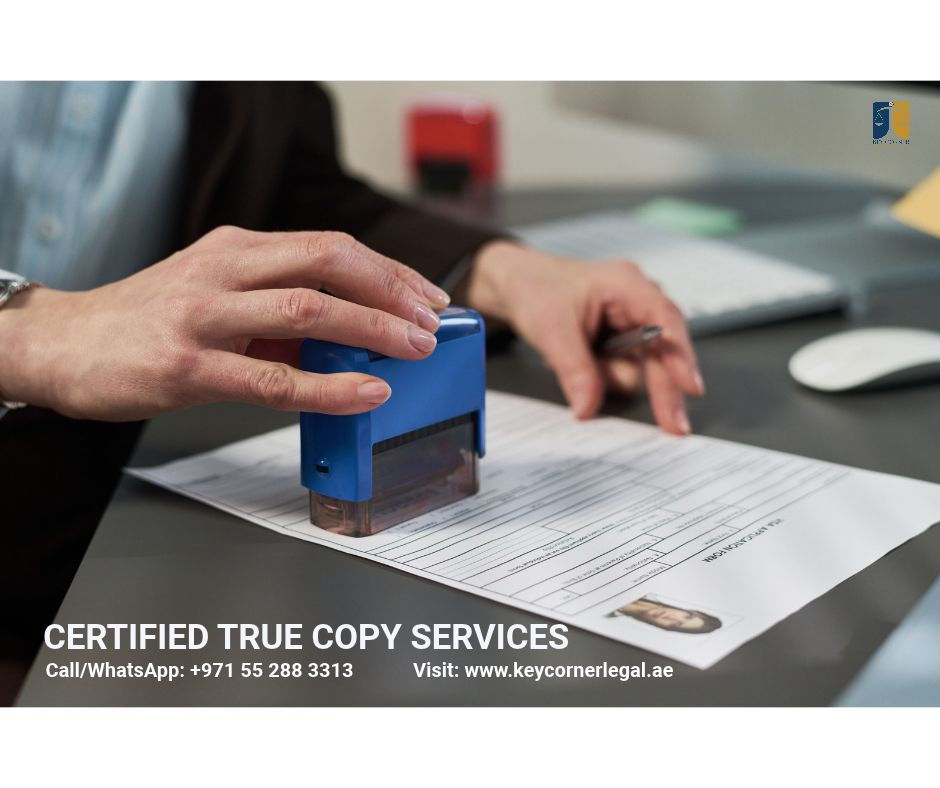
What Is a Certified True Copy?
A certified true copy is a reproduction of an original document that has been checked and certified as a true copy by an authorized person or organization, in accordance with the requirements applicable to that document.
The certification generally confirms that the copy corresponds to the original document presented for inspection. It does not necessarily confirm that the statements contained in the original document are factually correct, that the original is legally valid, or that the document has been authenticated by every authority that may require it.
For example, a company may request a certified true copy of a passport or company registration document as part of its verification process. An educational institution may request certified copies of academic certificates, while another organization may require additional attestation.
Important: Not every person or service provider is authorized to certify every type of document. Before obtaining certification, confirm who is permitted to certify the document and whether the receiving organization will accept that certification.
Why Do You Need a Certified True Copy in the UAE?
Certified true copies can help individuals and businesses provide copies of important records without submitting their original documents in every situation.
Some common reasons include the following.
1. Business and Corporate Transactions
Businesses may be asked to provide certified copies of corporate records, trade licences, shareholder documents, passports, or other supporting paperwork during onboarding, due diligence, and administrative procedures.
The exact documents and certification requirements depend on the requesting organization and the nature of the transaction.
2. Banking and Financial Requirements
Banks and financial institutions may request certified copies of identification documents, company records, ownership information, or other supporting documents.
Requirements vary between institutions, account types, and compliance procedures. A certified true copy should not be assumed acceptable without checking the bank's specific instructions.
3. Educational Applications
Schools, colleges, universities, and other educational institutions may request certified copies of certificates, diplomas, transcripts, or related academic documents.
Some applications may also require educational certificate attestation, equivalency procedures, translation, or verification by the issuing institution. A certified true copy is not automatically a substitute for these additional requirements.
4. Employment and Professional Applications
Employers, recruitment agencies, licensing bodies, and professional organizations may request copies of identification documents, academic qualifications, employment records, or professional certificates.
Before arranging certification, check whether the recipient requires a certified copy, an attested document, a verified electronic document, or the original record.
5. Immigration and Administrative Procedures
Certain applications involving government departments, immigration procedures, or other administrative matters may require certified copies of supporting documents.
The requirements depend on the particular application and the relevant authority. Some procedures require specific forms of authentication or direct submission of original documents.
6. Personal and Legal Matters
Individuals may need certified copies of documents for personal records, legal transactions, applications, or other formal purposes.
Where a document is intended for use in court proceedings or another regulated process, confirm the required format and certification procedure before preparing it.
Which Documents Can Be Submitted for True Copy Certification?
The documents that can be certified depend on the authority or professional providing the service and the intended use of the copy.
Common examples of documents for which certified copies may be requested include:
Passport copies
Emirates ID copies
Educational certificates and diplomas
Academic transcripts
Trade licences and commercial records
Company incorporation documents
Shareholder and corporate records
Certain financial or supporting documents
Personal certificates and other official records
Not every document is suitable for the same certification process. Some documents may require verification by the issuing authority, notarization, government attestation, or another prescribed procedure.
If you are unsure which procedure applies, check the receiving organization's written requirements before arranging the service.
Certified True Copy vs. Attestation: What Is the Difference?
One of the most common sources of confusion is the difference between a certified true copy and document attestation.
Although the terms are sometimes used interchangeably in everyday conversation, they can refer to different procedures.
Certified True Copy
A certified true copy generally confirms that the copy corresponds to the original document presented for comparison, when certified by an appropriately authorized person or organization.
Its purpose is to provide a certified copy rather than require the original to be submitted in every instance.
Document Attestation
Document attestation generally involves an authorized authority verifying a signature, seal, stamp, or other relevant element of a document under the applicable procedure.
Depending on the document and its intended use, attestation may involve a notary public, government department, embassy, consulate, or another designated authority.
Notarization
Notarization is a separate formal process performed by a notary public or other legally authorized official within the scope of their authority. Depending on the document, it may involve witnessing a signature, taking an oath or affirmation, or performing another notarial act.
Notarization does not automatically mean that every statement in a document has been independently verified.
Which Service Do You Need?
The correct service depends on what the receiving organization requires.
For example, an institution may accept a certified true copy, while another may require notarization or a chain of attestations. A document intended for use outside the UAE may have additional requirements in the destination country.
Before proceeding, confirm the exact wording of the requirement and the authority or professional permitted to perform the necessary procedure.
How Does the Certified True Copy Process Work?
The process depends on the type of document, the certifying authority, and the purpose for which the copy will be used. In general, you can prepare by following these steps.
Step 1: Identify the Document
Determine which document needs to be certified and why the receiving organization has requested it.
Check whether the requirement relates to an identification document, educational certificate, company record, personal certificate, or another type of record.
Step 2: Confirm the Receiving Organization's Requirements
Ask the organization requesting the document what form of certification it accepts.
Confirm whether the document must be certified by a particular professional, authority, or issuing institution, and whether any additional attestation or translation is required.
This step can help prevent unnecessary costs and delays.
Step 3: Prepare the Original Document
Keep the original document available for examination where required.
Check that it is legible and that the relevant details, stamps, signatures, and pages are visible. If the original is damaged, incomplete, or difficult to read, ask whether the receiving organization requires a replacement or additional verification.
Step 4: Arrange the Appropriate Certification
Present the original and any required supporting information to the person or organization authorized to provide the certification.
The certifying party may need to compare the copy with the original and apply the appropriate certification wording, signature, stamp, or other formalities.
The exact procedure depends on the applicable requirements.
Step 5: Review the Certified Copy
Before leaving, check that the certified copy is complete and that the certification details are clear.
Confirm that all required pages have been included and that the name, date, stamp, signature, or other necessary details are present where applicable.
Step 6: Submit the Document
Submit the certified copy according to the receiving organization's instructions.
Keep a copy of the certified document and any relevant receipt or service record for your reference.
Common Mistakes to Avoid When Certifying Documents
Even a straightforward document certification request can become inconvenient if the requirements are not checked in advance.
Here are some common mistakes to avoid.
Assuming every certification is accepted everywhere: Different institutions and authorities may have different requirements.
Confusing certification with attestation: A certified true copy may not satisfy a requirement for notarization or government attestation.
Providing an incomplete copy: Missing pages, unclear images, or cropped information may prevent acceptance.
Failing to bring the original: Where comparison with the original is required, a photocopy alone may not be sufficient.
Ignoring translation requirements: Documents in another language may require an accepted translation depending on the recipient's rules.
Overlooking overseas requirements: A document intended for use outside the UAE may need additional authentication or legalization.
Waiting until the last minute: Leaving document preparation until the application deadline may create avoidable stress if further formalities are needed.
A little preparation can make the process more straightforward and help you avoid repeating unnecessary steps.
Can a Certified True Copy Be Used Outside the UAE?
A certified true copy may be accepted outside the UAE, but acceptance depends on the destination country, the type of document, and the organization receiving it.
Some overseas institutions may accept a certified copy prepared by an appropriately authorized professional. Others may require notarization, government attestation, embassy or consular procedures, legalization, or additional verification.
For example, a document intended for a foreign university or government authority may be subject to requirements that differ from those applicable to a document used for a local business transaction.
Before arranging certification, ask the overseas recipient to confirm:
The required type of certification
Who is authorized to certify the document
Whether the original must be presented
Whether translation is necessary
Whether additional authentication or attestation is required
Confirming these details in advance can help reduce the risk of rejection.
Why Choose Key Corner Legal for Certified True Copy Services?
At Key Corner Legal, we understand that important documents often form part of essential personal, professional, educational, and business procedures.
We assist clients seeking certified true copy services and related document support in Dubai, Sharjah, and across the UAE, subject to the nature of the document and the applicable requirements.
Our approach focuses on understanding your needs, identifying the appropriate process, and helping you prepare your documents for the intended purpose.
Our Service Approach
Professional assistance: We help clients understand the document preparation and certification process relevant to their requirements.
Attention to detail: We encourage careful checking of document copies, completeness, and certification requirements.
Practical guidance: We help clients identify whether the receiving organization may require additional procedures beyond a certified true copy.
Support for individuals and businesses: We assist with document-related needs for personal applications, commercial transactions, and administrative procedures.
Convenient communication: Contact us to explain your requirements and confirm the applicable process, expected timeframe, and service charges before proceeding.
The appropriate certification method must always be confirmed for the specific document and intended use. We do not assume that one certification method is accepted by every institution or authority.
Frequently Asked Questions About Certified True Copy Services in the UAE
1. What is a certified true copy?
A certified true copy is a copy of an original document that has been checked and certified as a true copy by a person or organization authorized to provide that certification for the intended purpose.
2. Is a certified true copy the same as an attested document?
No, not necessarily. A certified true copy generally confirms that a copy corresponds to the original presented for comparison. Attestation involves a different verification or authentication procedure. The receiving organization determines which form it requires.
3. Do I need to bring the original document?
In many cases, the original must be presented so that the copy can be compared against it. However, requirements depend on the certifying authority and the type of document.
4. How long does certified true copy certification take?
The timeframe depends on the document, the service provider or authority, and any additional requirements. Some straightforward services may be completed quickly, while other documents may require further verification or formalities. Confirm the expected timeframe before proceeding.
5. Can I certify a passport or Emirates ID copy?
This depends on the applicable requirements and the person or organization authorized to certify the copy. Confirm whether the requesting institution accepts the proposed certification method before arranging the service.
6. Can educational certificates be certified as true copies?
Certified copies of educational certificates may be requested for various purposes. However, some institutions require educational verification, attestation, or equivalency procedures in addition to or instead of true copy certification.
7. Is a certified true copy valid for every government department?
No. Acceptance depends on the specific department, application, document type, and applicable requirements. Always confirm the required certification format with the receiving authority.
8. Can I use a certified true copy for an international application?
Possibly, but the destination country and receiving organization may impose additional requirements, including notarization, attestation, legalization, or translation.
9. Where can I get certified true copy services in Dubai or Sharjah?
You can contact Key Corner Legal to discuss your document requirements and determine the appropriate certification process, subject to the applicable authorization and requirements for your document.
10. What should I check before requesting certification?
Confirm the purpose of the document, the receiving organization's requirements, whether the original is needed, the identity of the authorized certifying party, and whether any additional procedures are necessary.
Conclusion: Get Your Documents Certified the Right Way
A certified true copy can be an important part of business transactions, educational applications, personal documentation, and administrative procedures in the UAE.
However, the correct process depends on the document and the organization requesting it. Understanding the difference between true copy certification, notarization, and attestation can help you select the appropriate service and avoid unnecessary delays.
Before arranging certification, confirm the requirements with the receiving organization and ensure that the person or organization providing the certification is authorized to do so for your intended purpose.
Whether you need help preparing a copy of an identification document, an educational certificate, a business record, or another important document, Key Corner Legal is ready to discuss your requirements and help you identify the appropriate next steps.
Contact Key Corner Legal Today
Need a certified true copy in Dubai, Sharjah, or elsewhere in the UAE?
Contact our team to discuss your document requirements, the applicable certification process, and the expected timeframe.
Key Corner Legal
Phone / WhatsApp: +971 55 288 3313
Email: info@keycornerlegal.ae
Key Corner Legal — Clear Guidance. Professional Document Support. Reliable Service.
Disclaimer: This article is for general informational purposes only and does not constitute legal advice. Certification, notarization, attestation, and document acceptance requirements may vary depending on the document, the relevant authority, and the intended use. Confirm the applicable requirements before relying on a certified document.


Comments